
The Model Context Protocol, MCP for short, is the standard way an AI assistant plugs into other software: your store, your inbox, your files, your payment provider. Two years after Anthropic published it, it has become the default. We pulled every server from the official MCP registry, version by version: 57,364 of them on 6 November 2026, up from about 1,200 at the end of 2025. For a merchant that is good news and a new kind of risk at the same time, because an MCP connection is not a report you read. It is a set of things an AI can do. This piece explains how MCP works, what the security research found, what changed for Shopify stores, and the questions to ask before you connect anything that can act.
What is the Model Context Protocol?
The Model Context Protocol is an open standard that defines how an AI application connects to external systems. An MCP server describes what it offers (tools the AI can call, data it can read, templates it can use) in a common format, and any MCP-compatible assistant can discover and use them without custom integration code.
Anthropic introduced MCP in November 2024 as an answer to a plumbing problem. Every AI product was writing its own connector to every other product, so connecting M assistants to N systems took M times N integrations. A shared protocol turns that into M plus N: each system publishes one MCP server, each assistant speaks MCP once. The usual analogy is a USB-C port for AI applications, and it is a fair one.
In December 2025 Anthropic handed MCP to the Agentic AI Foundation, a fund under the Linux Foundation co-founded with Block and OpenAI, so no single vendor controls it. By then OpenAI, Google and Microsoft products could all use MCP servers.
How does MCP work?
There are three roles. The host is the application you use, such as a chat assistant or a coding tool. Inside it, a client keeps a connection to each server, and each server wraps one external system. According to the specification, a server can offer three kinds of things:
- Tools: functions the AI model can decide to call, such as "search products", "create a discount" or "refund an order". This is the part that acts.
- Resources: data the AI or the user can read, such as a product catalogue or a document.
- Prompts: ready-made templates and workflows a user can pick from.
Servers run either on your own machine, talking to the host over standard input and output, or remotely over HTTP, in which case the specification defines an authorisation flow based on OAuth so the server knows who is calling and with what permission.
The part worth pausing on is how a model learns what a tool does: it reads the tool's description. A sentence of text written by whoever built the server tells the model what the tool is for and when to use it. The specification itself warns that descriptions of tool behaviour should be treated as untrusted unless they come from a trusted server. Hold that thought; it is where most of the risk lives.
How big has MCP become?
Big, and very quickly. Most published figures are secondhand, so we went to the source. The official MCP Registry, launched in preview in September 2025, has a public API. On 6 November 2026 we pulled every server and every version from it and kept the date each server first appeared.
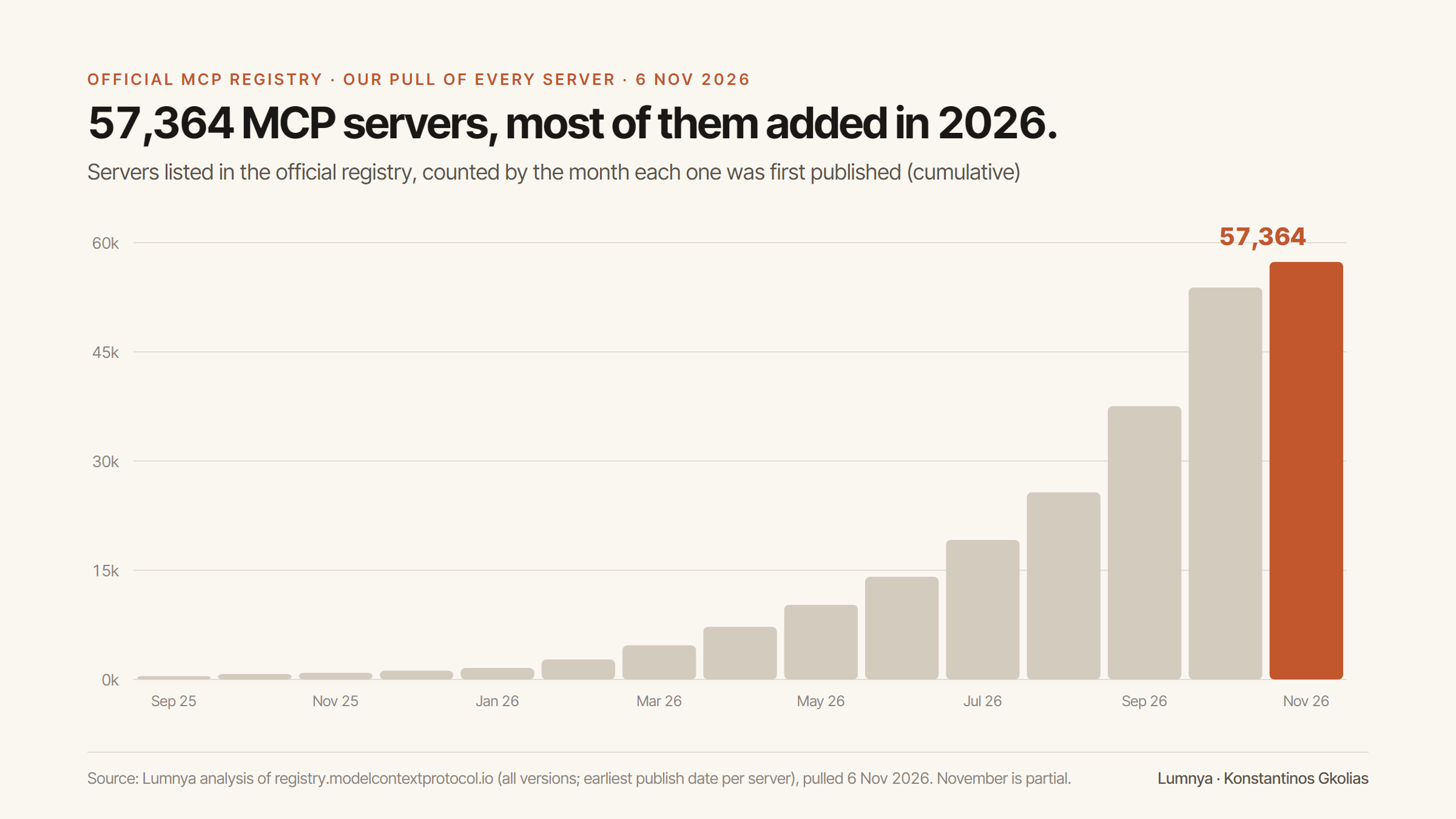
Three things stand out in the data:
- Almost all of it is from 2026. The registry held 1,201 servers at the end of 2025. October 2026 alone added 16,288, more than the whole of the first five months of the year.
- Two thirds are hosted. 67% of servers offer a remote endpoint, which means connecting one is often a matter of pasting a URL and signing in, not installing software.
- Commerce is a small corner, so far. By a keyword match on names and descriptions, 1,049 servers relate to stores, payments, orders, inventory or checkout, about 1.8% of the total; 179 mention Shopify.
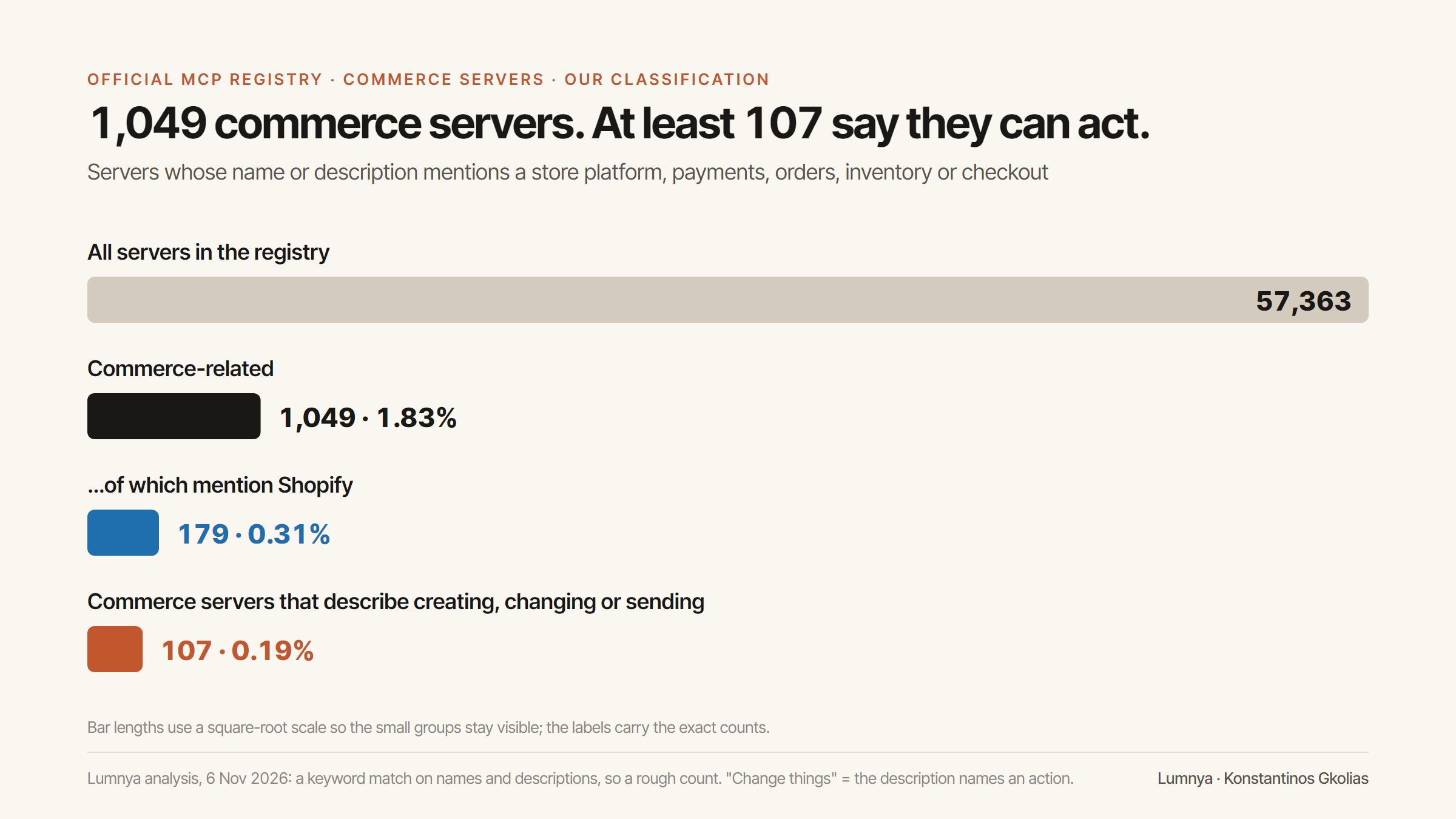
That last number deserves its caveat. Our classifier counts a server as one that acts only when its description uses a verb such as create, update, refund or send. Plenty that act describe themselves differently ("control Shopify admin tasks", "push products to Shopify") and slip through, so 107 is a floor. The useful point is not the exact count. It is that a merchant can now find, in one public list, servers that will let an AI edit products, move inventory or touch orders, written by companies they have never heard of.
MCP, APIs and apps: what is actually new?
If you have run a Shopify store for a while, none of this sounds new. Apps already connect to your store through Shopify's API, with permissions you approve on install. So what does MCP change?
Three things. First, who decides what happens next. An app runs the code its developer wrote: press a button, get a report. An MCP server offers a menu of tools, and an AI model chooses from that menu at run time, in response to a conversation. The same server can do something different every time it is used.
Second, how the capabilities are described. An API is documented for human developers, who read the docs once and write code against them. An MCP tool is described for the model, in natural language, at the moment it is used. That is what makes MCP so easy to adopt, and it is also why a description can be used to steer the model.
Third, how many systems one conversation can reach. An assistant can hold connections to several servers at once: your store, your email, your files, a supplier's catalogue. Each connection on its own may be harmless. Together they can create the combination security researchers worry about most: access to private data, exposure to text from strangers, and a way to send something out.
None of this is a flaw in the protocol. It is what a general-purpose plug for AI means. A merchant who understands that the plug carries actions, not only data, is most of the way to using it safely.
What does MCP mean for a Shopify store?
For Shopify merchants, MCP arrives from two directions.
Shopify's own servers. Shopify publishes MCP servers for developers (documentation and API schemas for AI coding tools) and for shopping agents. In 2026 it reorganised the shopping side: the catalogue and cart tools of its original Storefront MCP were removed, and the migration page points agent builders to new endpoints built on the Universal Commerce Protocol: separate MCP servers for searching the catalogue, building carts, starting checkout and answering policy questions. Agents identify themselves with a profile on every request. We cover UCP itself in the next piece in this series.
Everyone else's servers. The 179 Shopify-related servers in the registry range from read-only analytics to full admin control. Connecting one to your AI assistant gives that assistant whatever the server can do, under whatever permission you granted when you signed in.
The difference from an ordinary app install is subtle and important. A normal Shopify app does what its code does. An MCP server does what an AI model decides to ask it to do, based on your instructions, the server's descriptions, and anything else in the conversation, including text written by strangers.
Is MCP safe? What the research found
Two studies give the clearest picture so far.
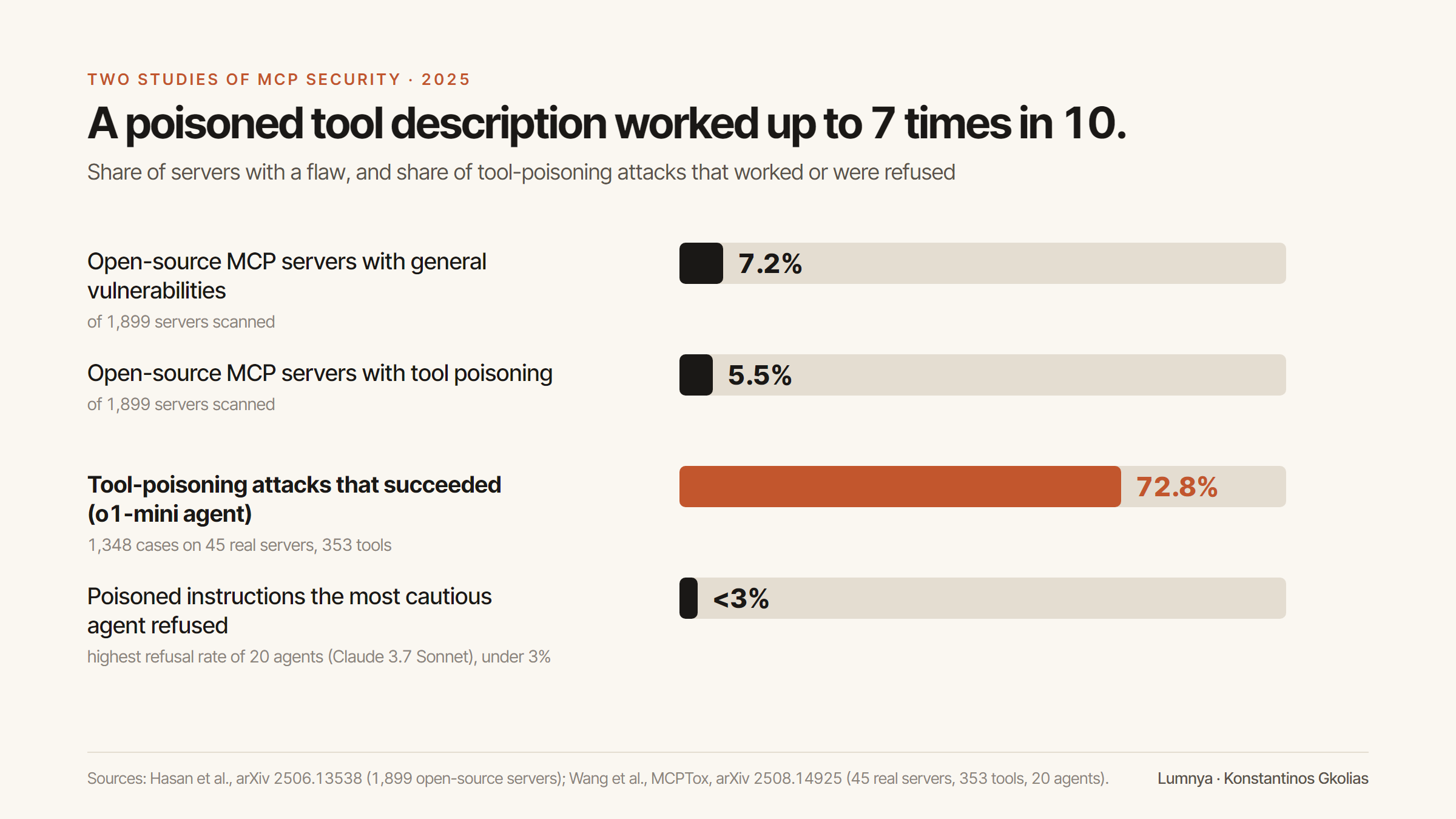
The first, by Hasan and colleagues, scanned 1,899 open-source MCP servers and found that 7.2% contained general security vulnerabilities and 5.5% showed MCP-specific tool poisoning: instructions hidden in a tool's description that steer the model. Most servers were otherwise healthy software. The new risks were the ones traditional scanners are not built to see.
The second, MCPTox, tested what tool poisoning does in practice: 1,348 attack cases built on 45 real servers and 353 real tools, run against 20 AI agents. The most affected agent followed the poisoned instructions 72.8% of the time, more capable models were often more susceptible, and the most cautious agent refused fewer than 3% of the attacks. A poisoned description does not need the model to run the bad tool. It can tell the model to misuse a good one, such as a legitimate "send email" tool.
This is the same weakness we described in What is prompt injection?, arriving through a new door. In May 2025 Invariant Labs showed it with GitHub's own official server: an issue posted on a public repository could steer a connected agent into leaking a developer's private code, and their write-up concluded that the fix had to be architectural, not a patch.
The lesson for a merchant is not "avoid MCP". The protocol is sound and its authors are explicit about trust. The lesson is that every MCP server you connect adds tools, and every tool is a capability that text can try to trigger.
Five questions before you connect an MCP server to your store
- What can it do, exactly? Ask for the list of tools. Read-only tools (search, report, look up) carry far less risk than tools that create, change, refund, send or delete. If you only need reports, connect a server that only reads.
- What permission does it ask for? A server that signs in to your store inherits the scopes you approve. Approve the narrowest set. A "manage everything" grant for a reporting task is a red flag.
- Who wrote it, and who hosts it? A server published by the platform itself or by a company you already trust is different from one published days earlier by an account with no history. Check the publisher, the source code if it is open, and how often it is updated.
- Does anything require a person before an action? The assistant you connect it to should ask before any tool that moves money, changes prices or messages customers. If it can be set to run those on its own, find out who decides that and where.
- What else does the assistant read? Tool poisoning and prompt injection both work by putting text where the model will read it. An assistant that reads your support inbox and holds an MCP connection to your admin has exactly the combination that research warns about.
How Lumnya approaches it
Lumnya does not hand a general-purpose MCP connection to an AI with your store's full permissions. Our agents call a fixed set of tools inside our own system, and we apply the same principles the research points to:
- Two separate tool sets. The assistant that talks to shoppers has a much smaller set of tools than the one that works for the merchant. It has no tool to refund an order at all, so no text can make it do so.
- No climbing. When one of our agents hands work to another, the second one can never run with more privilege than the first. A shopper-facing agent cannot recruit an admin one.
- Actions that matter ask first. Refunds, decisions on returns and emails to customers wait for the merchant's confirmation, and the limits on everything else are checked by our code, not by the model.
- One store's data, one store's agent. Every read and write is scoped to the store it belongs to, so an agent working for one merchant cannot reach another's data.
This is narrower than "connect anything", on purpose. We wrote about the underlying rule, that a check only protects you if it runs before the action, in our piece on AI agent guardrails.
Where we could be wrong
Our registry numbers measure the official registry, not all MCP servers in existence; many live only on GitHub or inside companies, and some registry entries are test servers that will never be used. The keyword classification of commerce servers is rough in both directions, and the count of servers that can act is certainly too low. The security studies are from 2025 and both the protocol and the models have moved since: the specification now says more about authorisation and trust, and newer models may resist poisoning better. And MCP's rapid growth is also its strength: a single standard is far easier to secure than a thousand custom integrations, which is the world it replaced.
The short version
- MCP is the standard plug between AI assistants and other software. A server offers tools (actions), resources (data) and prompts (templates).
- The official registry grew from about 1,200 servers at the end of 2025 to 57,364 on 6 November 2026; about 1.8% relate to commerce and 179 mention Shopify.
- In the research, 5.5% of open-source servers carried tool poisoning, and poisoned descriptions worked up to 73% of the time against a test agent.
- Before you connect a server to your store, ask what it can do, what permission it gets, who wrote it, whether actions need a person, and what else the assistant reads.
Frequently asked questions
What is the Model Context Protocol in simple terms?
It is a common plug that lets an AI assistant connect to other software, such as a store, a calendar or a database, and use its tools. Instead of every assistant needing a custom integration for every system, each system offers one MCP server that any compatible assistant can use.
Who created MCP and who owns it now?
Anthropic introduced it in November 2024. In December 2025 it was donated to the Agentic AI Foundation, a fund under the Linux Foundation co-founded by Anthropic, Block and OpenAI, so it is now governed as an open standard.
Is MCP secure?
The protocol defines how servers authenticate and warns that tool descriptions should be treated as untrusted unless the server is. The risks come from what individual servers expose and from the AI being steered by text, such as poisoned tool descriptions. Connect only servers you trust, with the narrowest permissions, and require a person's approval for actions that move money or reach customers.
Is MCP the same as an API?
No. MCP sits on top of APIs. An MCP server usually calls a system's ordinary API behind the scenes, but it describes its tools in a form an AI model can discover and choose from during a conversation, instead of a form a developer reads once and codes against.
Does Shopify support MCP?
Yes. Shopify offers MCP servers for developers and, for shopping agents, MCP endpoints built on the Universal Commerce Protocol for catalogue search, carts, checkout and store policy questions. Its original Storefront MCP catalogue and cart tools were moved to those endpoints in 2026.
Sources
- [1] Anthropic, “Introducing the Model Context Protocol”, 25 Nov 2024 (accessed 2026-11-06)
- [2] Anthropic, “Donating the Model Context Protocol and establishing the Agentic AI Foundation”, 9 Dec 2025 (accessed 2026-11-06)
- [3] Model Context Protocol, “Specification, version 2025-11-25” (accessed 2026-11-06)
- [4] Official MCP Registry and its public API (accessed 2026-11-06). Our pull, scripts and data:
data/beside this article (57,363 latest records; 57,364 servers across all versions). Link - [5] Model Context Protocol Blog, “Introducing the MCP Registry”, 8 Sep 2025 (accessed 2026-11-06)
- [6] Shopify, “Migrate from Storefront MCP” (accessed 2026-11-06)
- [7] Shopify, “Build commerce agents with UCP” (accessed 2026-11-06)
- [8] Hasan et al., “Model Context Protocol (MCP) at First Glance: Studying the Security and Maintainability of MCP Servers”, arXiv 2506.13538, Jun 2025 (accessed 2026-11-06)
- [9] Wang et al., “MCPTox: A Benchmark for Tool Poisoning Attack on Real-World MCP Servers”, arXiv 2508.14925, Aug 2025 (accessed 2026-11-06)
- [10] Lumnya, “What is prompt injection? How an AI agent gets talked into acting”, 2 Dec 2026 (accessed 2026-11-06).
- [11] Invariant Labs, “GitHub MCP exploited: accessing private repositories via MCP”, May 2025 (accessed 2026-11-06)
- [12] Lumnya, “AI agent guardrails: a check after the action is a log”, 6 Nov 2026 (accessed 2026-11-06)
- [13] Lumnya product behaviour described here was checked against Lumnya's code on 6 November 2026: agent scopes and the spawn check, the storefront tool set, the autonomy policy engine, and the store-scoped data helpers.
Lumnya is a team of ecommerce AI agents for Shopify stores, now in private beta. Join the waitlist.
Comments
…Every comment is read and approved by a human before it appears — the same confirm-gated rule the product runs on.
Loading comments…
Filed under AI & Commerce
All posts