
Agentic commerce is shopping in which an AI agent does part of the work a person used to do: it searches, compares, builds the cart and, more and more often, checks out. In little more than a year, the largest companies in AI and payments published the rules for how it works: OpenAI and Stripe's Agentic Commerce Protocol, Google's Universal Commerce Protocol, Google's Agent Payments Protocol, all running over the Model Context Protocol. Adobe expects visits to US retail sites from AI assistants to grow 130% this holiday season. This piece explains what each protocol does in plain terms, what changes for a store when its visitor is software, and the three things a merchant should do about it.
What is agentic commerce?
Agentic commerce is buying and selling in which an AI agent acts for the buyer for part or all of the purchase: finding products, comparing them, assembling a cart, paying, and following up on the order. The merchant still sells, ships and remains responsible for the sale. What changes is who, or what, is reading the store.
It helps to separate three levels, because the term is used for all of them:
- AI-assisted shopping. A person asks an assistant for recommendations and clicks through to a store. This is already large: it is what Adobe measures as AI-referred traffic.
- In-chat checkout. The person decides, but buys without leaving the assistant. The assistant hands the order to the merchant through a protocol.
- Delegated buying. The person sets a goal ("reorder coffee when it runs low, under 20 euros") and the agent completes purchases within limits, with proof that the person agreed.
Most of the protocols below exist to make levels 2 and 3 work without every assistant writing a custom integration for every store.
How fast is it growing?
Fast enough that the holiday forecasts now carry a line for it. In its 2026 holiday forecast, Adobe expects AI-referred traffic to US retail sites (measured as shoppers clicking a link in an AI assistant) to rise 130% year on year across November and December, with the biggest jump on Thanksgiving.
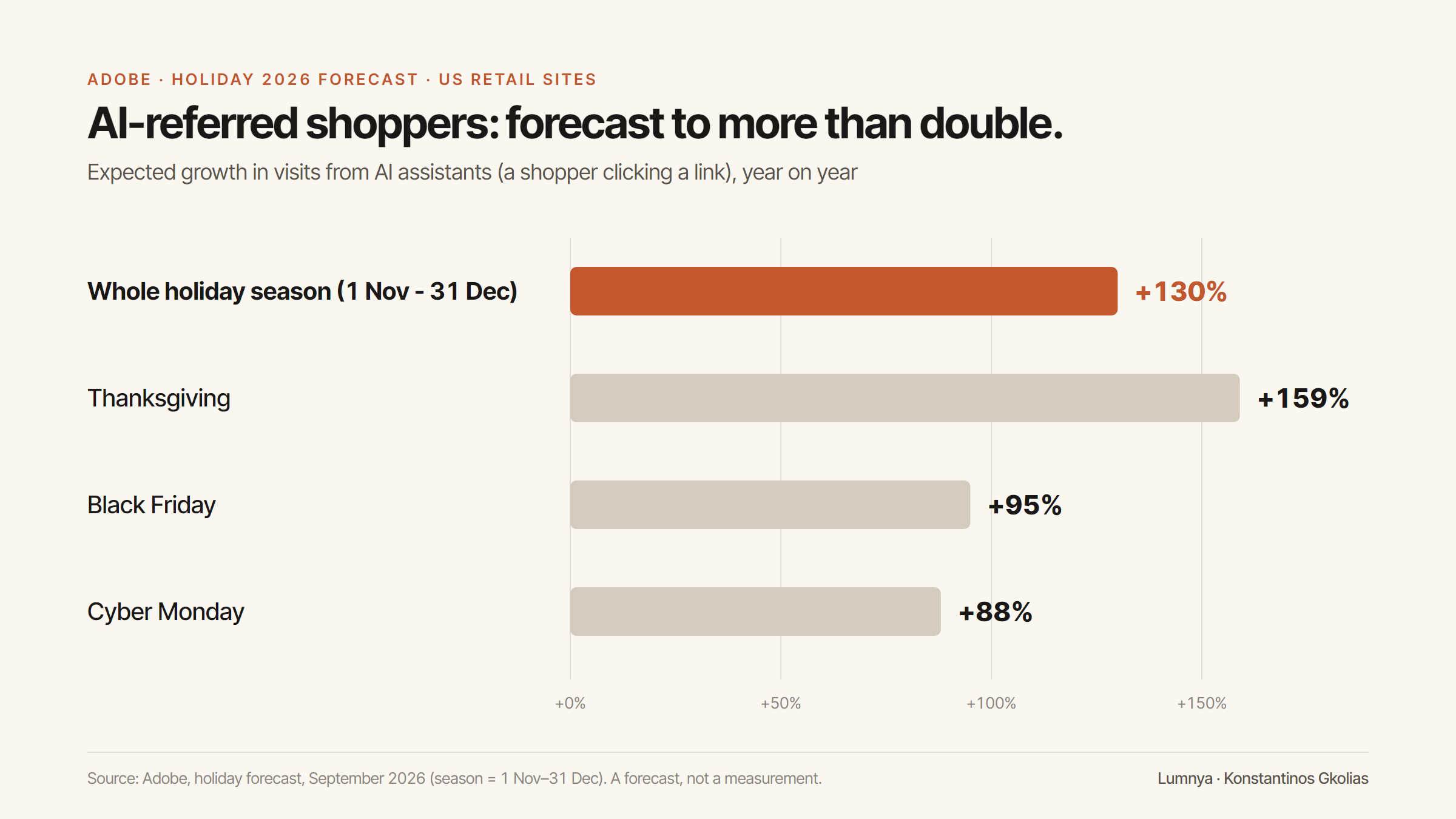
Two cautions. These are forecasts, not measurements, and growth rates on a small base always look dramatic. AI assistants still send a small share of retail traffic compared with search and social. But the audience behind them is not small: when OpenAI launched checkout inside ChatGPT, it said more than 700 million people were using ChatGPT every week. The direction is not in doubt. The share, for any given store, is worth measuring rather than guessing.
The protocols, in plain terms
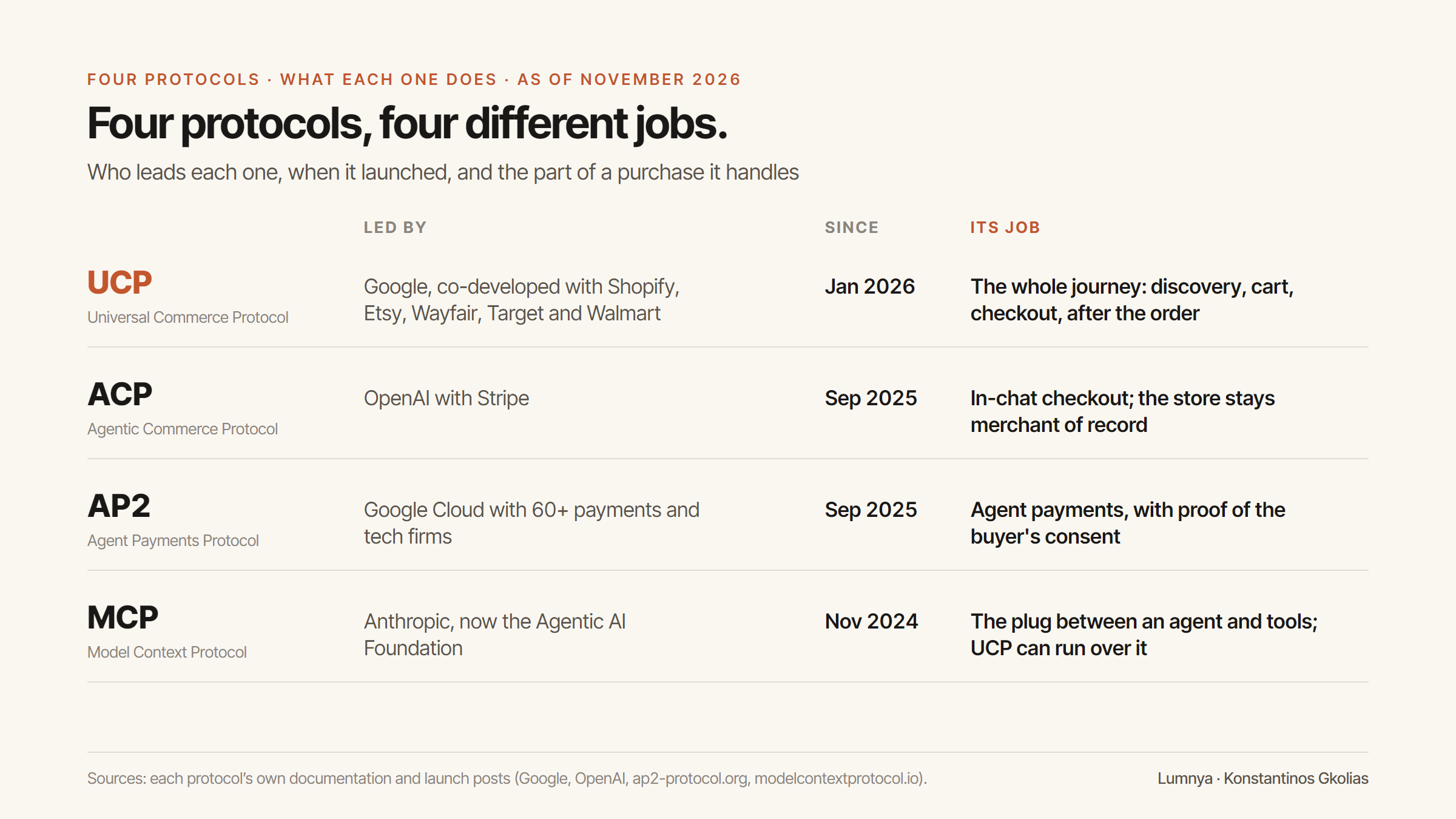
Four protocols come up whenever agentic commerce is discussed. They are often presented as rivals. They are better understood as layers with different jobs.
ACP: checkout inside the assistant
The Agentic Commerce Protocol was published by OpenAI and Stripe in September 2025, together with Instant Checkout in ChatGPT. It defines how an assistant hands a purchase to a business: the product information the business shares, the checkout session, and how payment details pass from the buyer to the merchant's payment provider without the assistant holding them. Its own documentation stresses that the business stays the merchant of record and keeps control over what it sells and how orders are fulfilled. Stripe described its role in developing an open standard for agentic commerce.
UCP: the whole journey
The Universal Commerce Protocol was announced by Google in January 2026, co-developed with Shopify, Etsy, Wayfair, Target and Walmart and endorsed by more than twenty other companies, according to Google's technical write-up. Where ACP concentrates on checkout, UCP aims to standardise the full path from discovery through cart and checkout to what happens after the order, and it can run over ordinary APIs, over the Agent2Agent protocol or over MCP. Its specification lives at ucp.dev.
AP2: payments with proof of consent
The Agent Payments Protocol was announced by Google Cloud in September 2025 with more than sixty payments and technology firms. It deals with the hardest part of delegated buying: proving that a person really authorised an agent to pay, and for what. It is designed as an extension that works with UCP and with the Agent2Agent protocol.
MCP: the plug underneath
The Model Context Protocol is not a commerce protocol at all. It is the general way an AI agent connects to tools, and several commerce standards use it as their transport. We explained it, with a count of every server in its official registry, in Model Context Protocol explained.
What changes for a Shopify store?
For Shopify merchants, the most concrete change is already in place. Shopify's developer documentation now directs anyone building a shopping agent to build on UCP, with separate endpoints for searching a store's catalogue, building carts, starting checkout and asking policy questions, served from an address on each store's own domain. The older Storefront MCP catalogue and cart tools were removed and mapped to these UCP equivalents, as its migration page explains. Agents identify themselves with a profile on every request.
In practice that means three things change when the visitor is an agent rather than a person:
- The agent reads your data, not your design. Photography, layout and copy tone matter less. Product attributes, variant names, stock, shipping times and policy text matter more, because that is what the agent compares.
- The agent compares you with everyone, instantly. A person might open four tabs. An agent can check dozens of stores in one request, and it will notice a vague return policy or a missing size chart.
- The agent repeats what you wrote, literally. If two pages of your store disagree, the agent may quote either one, and the shopper will hold you to it.
The third point is the one most stores are not ready for, and the one that costs money.
The problem nobody talks about: your store has many copies
A store is not one document. It is a catalogue, a set of product feeds, policy pages, an FAQ, help articles, reviews and answers in a chat knowledge base, all written at different times by different people. A person browsing usually lands on one or two of them. An agent can read them all, and it cannot tell which one is current.
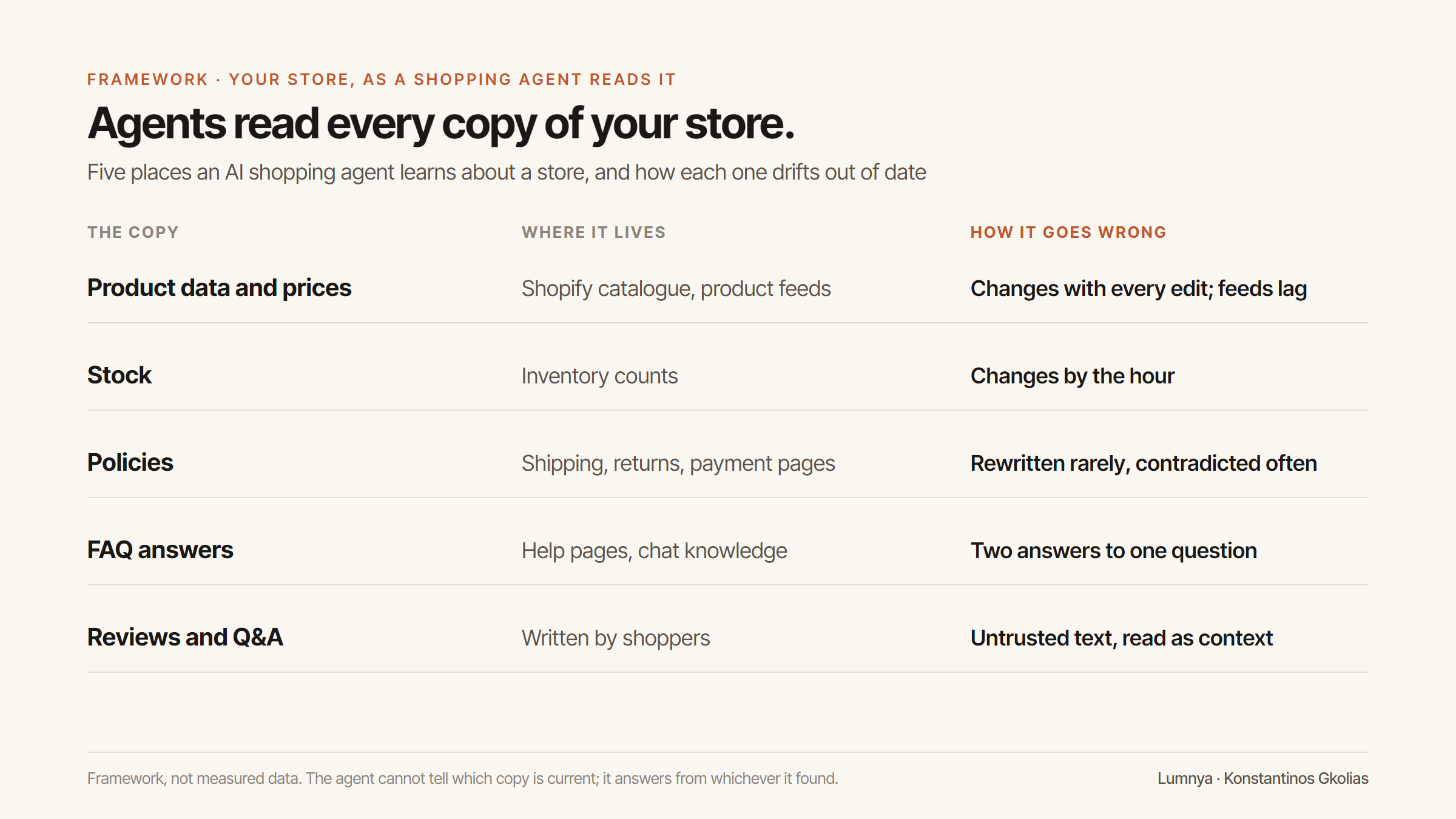
We found a typical case on one of our own development stores in October 2026. Two FAQ answers about shipping to Cyprus disagreed: one said five to seven working days, the other three to five. An assistant answering a shopper picked whichever answer its search ranked first, so the promise depended on how the question was phrased. Nobody had written anything false on purpose. The store simply had two copies of one fact.
Multiply that by every policy, every product and every agent that will read your store, and the risk is clear. We wrote about the same pattern from the agent's side in AI shopping agents read your store in copies.
Three things a merchant should do
1. Make your facts agree with each other
Before you optimise anything for agents, find the places where your store contradicts itself. Search your FAQ, policy pages and help articles for every number: delivery times by country, return windows, free-shipping thresholds, discount terms. Put each number in one place and make every other page point to it or match it exactly. The goal is that any agent, reading any page, gets the same answer.
2. Make your products readable without the pictures
Agents choose on attributes. Check that every product has a clear title, the variant names a shopper would use ("navy, size 40"), materials, dimensions, compatibility, and accurate stock. Fill in the structured fields your platform offers rather than putting key facts only in an image or a paragraph of marketing copy. A product an agent cannot understand is a product it cannot recommend.
3. Decide your rules before an agent asks
Agents will ask questions your website never had to answer explicitly: can this be delivered by Friday, can the order be split, will you accept a return if the box is opened? Write the answers down as policy, not as something a person on your team decides case by case. And decide what your own AI tools may do in response: an agent negotiating with your store's assistant is still text from a stranger, so refunds and exceptions should still need a person.
What to measure, and what agentic commerce is not
Before investing in any of this, find out how much of it already reaches your store. Most analytics tools, Shopify's included, show the referring site for each session. Look for visits from the AI assistants your customers use, compare their conversion rate and average order with your other channels, and watch the trend from month to month. A store that sees a handful of such visits has time; a store that sees them double every quarter should move the three steps above up its list.
Also look at what those visitors asked for. If your store has an on-site assistant or search, the questions that arrive from AI-referred visitors are often more specific than average ("waterproof, under 150 euros, ships to Ireland by Friday"), because the outside assistant has already done the browsing. Those questions are a precise list of the facts your store has to state clearly.
It is just as useful to be clear about what agentic commerce is not.
- It is not the end of the website. People still visit stores, and agents still send many of them there to finish the purchase. The site becomes one of several surfaces that must tell the same story.
- It is not AI running your store. The protocols describe how a buyer's agent talks to a store. They do not decide your prices, your stock or your policies, and nothing in them requires you to let an AI change those on its own.
- It is not a reason to trust text from agents. An agent placing an order is a customer. An agent's message asking your support assistant for an exception is still text written by someone else, and it deserves the same caution as any other.
Treated this way, agentic commerce is less a revolution than a stricter reader. It rewards stores whose facts are clear and consistent, and it exposes the ones whose facts are not.
How Lumnya helps with the second copy problem
Lumnya works on the merchant's side, not as a checkout for agents. The part of agentic commerce we can help with is the one in section three: making sure the store an agent reads says one consistent thing.
- It looks for contradictions in your FAQ. Lumnya reads your FAQ answers for pairs that state different numbers about the same subject, such as two delivery times for the same country, and asks you which one is right. No AI model makes that judgement; the check compares the numbers themselves, so it cannot be talked into or out of a finding.
- Your assistant answers from your policies, not from habit. When Lumnya's storefront assistant states a duration, a percentage or a "free" about shipping, returns, discounts or payment, it must match the store's own policy, threshold included, or the store's own answer replaces it.
- It asks, it doesn't overwrite. A contradiction is your decision. Lumnya raises it once, in your inbox, and leaves the fix to you.
Where we could be wrong
The protocols are young and moving: names, scopes and endpoints have already changed within a year, and some of what is described here will look different by the time it matters to most stores. AI-referred traffic is forecast to grow fast from a small base, and for many merchants it will remain a minor channel for a while; the advice in this piece is cheap enough to be worth doing either way. We may also be underestimating how much the assistants will do on their own to resolve contradictions. Better models could learn to spot two conflicting FAQ answers and ask. We would still rather a store did not depend on that.
The short version
- Agentic commerce is shopping in which an AI agent does part of the buying: from recommendations, to checkout inside the assistant, to purchases delegated within limits.
- ACP (OpenAI and Stripe) handles checkout inside an assistant; UCP (Google with Shopify and major retailers) covers the whole journey; AP2 proves a person authorised an agent's payment; MCP is the plug underneath.
- Adobe forecasts AI-referred visits to US retail sites up 130% this holiday season. On Shopify, agent builders are now directed to UCP endpoints on each store's domain.
- Make your facts agree with each other, make your products readable without the pictures, and write your rules down before an agent asks.
Frequently asked questions
What is agentic commerce in simple terms?
It is shopping where an AI assistant does some of the work for the buyer: searching, comparing, adding to cart and sometimes paying. The merchant still sells and ships; the difference is that the store is read and compared by software on the buyer's behalf.
What is the difference between UCP and ACP?
ACP, from OpenAI and Stripe, focuses on checkout inside an AI assistant while the store stays merchant of record. UCP, from Google with Shopify and large retailers, aims to standardise the whole journey from discovery to after the order. They overlap at checkout, and many merchants will meet both.
Do I need to do anything technical to sell through AI agents on Shopify?
For most merchants, the platform handles the protocol side; Shopify directs agent builders to UCP endpoints on each store's domain. What a merchant controls is the quality of what agents read: consistent policies, complete product data and clear rules.
What is AI-referred traffic?
It is visits to a store that start with a shopper clicking a link inside an AI assistant such as ChatGPT, Gemini or Perplexity. Adobe uses this measure in its retail forecasts. It is the easiest part of agentic commerce to see in your own analytics, because the assistant appears as the referring site, and it is the best early signal of how much of your audience already shops through an assistant.
Is agentic commerce safe for merchants?
The protocols keep the merchant as merchant of record and route payments through payment providers rather than the assistant. The new risks are on the content side: agents repeating contradictory information, and text from agents or strangers reaching your own AI tools. Keep refunds and exceptions behind a person's approval.
Sources
- [1] Adobe, “U.S. Holiday Shopping Season to Hit Record $275.1 Billion Online, Rising 6.7% YoY”, Sep 2026 (accessed 2026-11-06)
- [2] Agentic Commerce Protocol, official site and documentation (accessed 2026-11-06) Link
- [3] OpenAI, “Buy it in ChatGPT: Instant Checkout and the Agentic Commerce Protocol”, 29 Sep 2025 (accessed 2026-11-06)
- [4] Stripe, “Developing an open standard for agentic commerce” (accessed 2026-11-06)
- [5] Google for Developers, “Under the Hood: Universal Commerce Protocol (UCP)”, 11 Jan 2026 (accessed 2026-11-06)
- [6] Universal Commerce Protocol, specification (accessed 2026-11-06) Link
- [7] Agent Payments Protocol (AP2), documentation (accessed 2026-11-06) Link
- [8] Lumnya, “Model Context Protocol explained”, 6 Dec 2026 (accessed 2026-11-06).
- [9] Shopify, “Build commerce agents with UCP” (accessed 2026-11-06)
- [10] Shopify, “Migrate from Storefront MCP” (accessed 2026-11-06)
- [11] Lumnya, “AI shopping agents read your store in copies: make them agree”, 21 Oct 2026 (accessed 2026-11-06)
- [12] Lumnya product behaviour described here was checked against Lumnya's code on 6 November 2026: the merchant consistency checks (FAQ conflicts) and the policy-fact gate.
Lumnya is a team of ecommerce AI agents for Shopify stores, now in private beta. Join the waitlist.
Comments
…Every comment is read and approved by a human before it appears — the same confirm-gated rule the product runs on.
Loading comments…
Filed under AI & Commerce
All posts