
"AI agent" now describes everything from an email that fires when a cart is abandoned to an assistant that buys a coffee machine on your behalf when its price drops. Gartner estimates that only about 130 of the thousands of companies selling "agentic AI" are offering the real thing, and expects more than four in ten agent projects to be cancelled by the end of 2027. This piece gives you the vocabulary to tell them apart: the five classic types of AI agent, each with an everyday ecommerce example, and then the question that matters more for a business than the type, which is how far a given agent is allowed to go. We place five agents that ship in real products on that ladder, using only what their makers say they may do.
What is an AI agent?
An AI agent is software that perceives its environment, decides what to do, and acts to achieve a goal, with some degree of independence from the person who set it up. The textbook definition, from Russell and Norvig's Artificial Intelligence: A Modern Approach, is broader still: anything that perceives through sensors and acts through actuators counts as an agent, from a thermostat to a self-driving car.
That breadth is why the word causes confusion. In 2026 most people who say "AI agent" mean something narrower: a system built around a large language model that can call tools (search a catalogue, look up an order, send a message) and decide which ones to use in response to a request. Both meanings are useful. The classic one tells you how an agent decides. The modern one raises the question this piece is really about: what it is allowed to do once it has decided.
How big is the agent wave, and how much of it is real?
Gartner's June 2025 forecast on agentic AI captures both sides of the moment in one document.
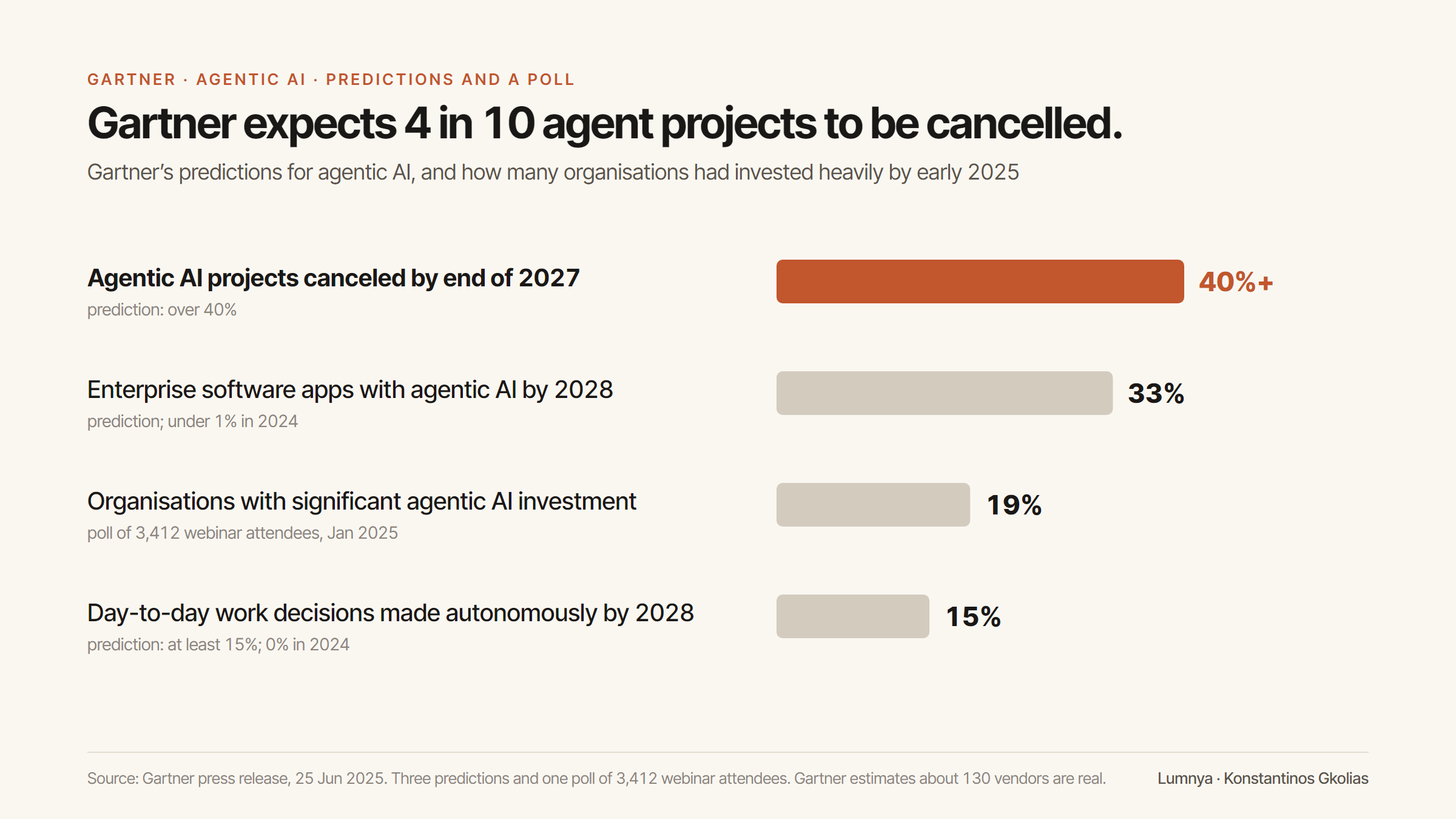
On one side, the adoption curve is steep: from under 1% of enterprise applications including agentic AI in 2024 to a predicted 33% by 2028. On the other, Gartner expects more than 40% of agentic AI projects to be cancelled by the end of 2027, citing rising costs, unclear business value and inadequate risk controls, and it names the practice of rebranding existing chatbots and automation tools as agents "agent washing". Its estimate that only about 130 of the thousands of agentic AI vendors are real is the most useful single number in the document for anyone being sold one.
The five types of AI agent, with an ecommerce example of each
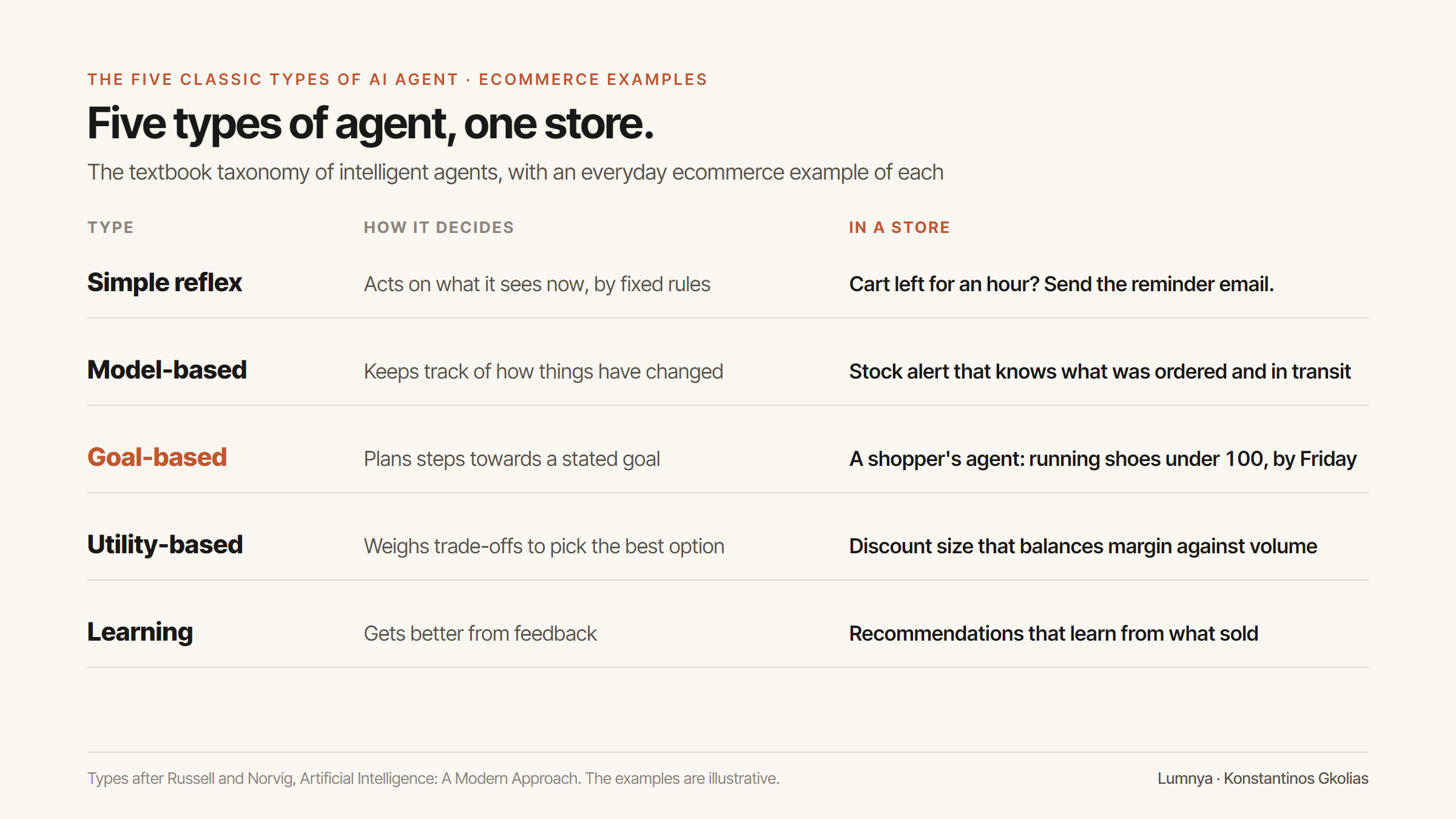
The classic taxonomy sorts agents by how they decide. It is old, it is still the clearest, and every agent you will meet in a store fits one of its five boxes.
1. Simple reflex agents
A simple reflex agent acts on what it perceives right now, using fixed condition-action rules. It has no memory and no plan. Example: the abandoned-cart email. If a cart has been inactive for an hour and the shopper has an email address, send the reminder. Most store automation is this type, and there is nothing wrong with that: it is predictable, cheap and easy to audit.
2. Model-based reflex agents
A model-based agent keeps an internal picture of the world so it can act sensibly when it cannot see everything at once. Example: a low-stock alert that remembers what has already been ordered from the supplier and what is in transit, so it does not tell you to reorder something that will arrive on Tuesday. Same rules, better context.
3. Goal-based agents
A goal-based agent considers future states and chooses actions that move it towards a goal. Example: a shopper's assistant asked for "running shoes under 100, delivered by Friday". It searches, filters, compares delivery dates and proposes a choice. This is where most of the new agentic commerce sits, from OpenAI's Instant Checkout to Google's shopping tools, as we explained in Agentic commerce explained.
4. Utility-based agents
A utility-based agent goes further than "goal reached or not": it scores outcomes and picks the best trade-off. Example: choosing a discount for slow stock. Ten percent may not move it; thirty percent may move it at a loss. The agent weighs margin against volume and clearance date and picks the size with the best expected result. Ad-bidding systems are the most common utility-based agents in commerce.
5. Learning agents
A learning agent improves its own behaviour from feedback. Example: product recommendations that learn from what shoppers clicked and bought, so the suggestions get better with every order. Most modern systems combine this with one of the types above.
Here is the problem with the taxonomy, for a merchant. It tells you how an agent thinks. It says nothing about what it can do to your store or your customers. A simple reflex agent with access to your refund button is more dangerous than a learning agent that can only suggest products.
The question that matters more: how far is it allowed to go?
For a business, the useful way to sort AI agents is by autonomy: what the agent may do without a person, and what it must ask first. We placed five agents that ship in real products on a ladder, using only their makers' own documentation.
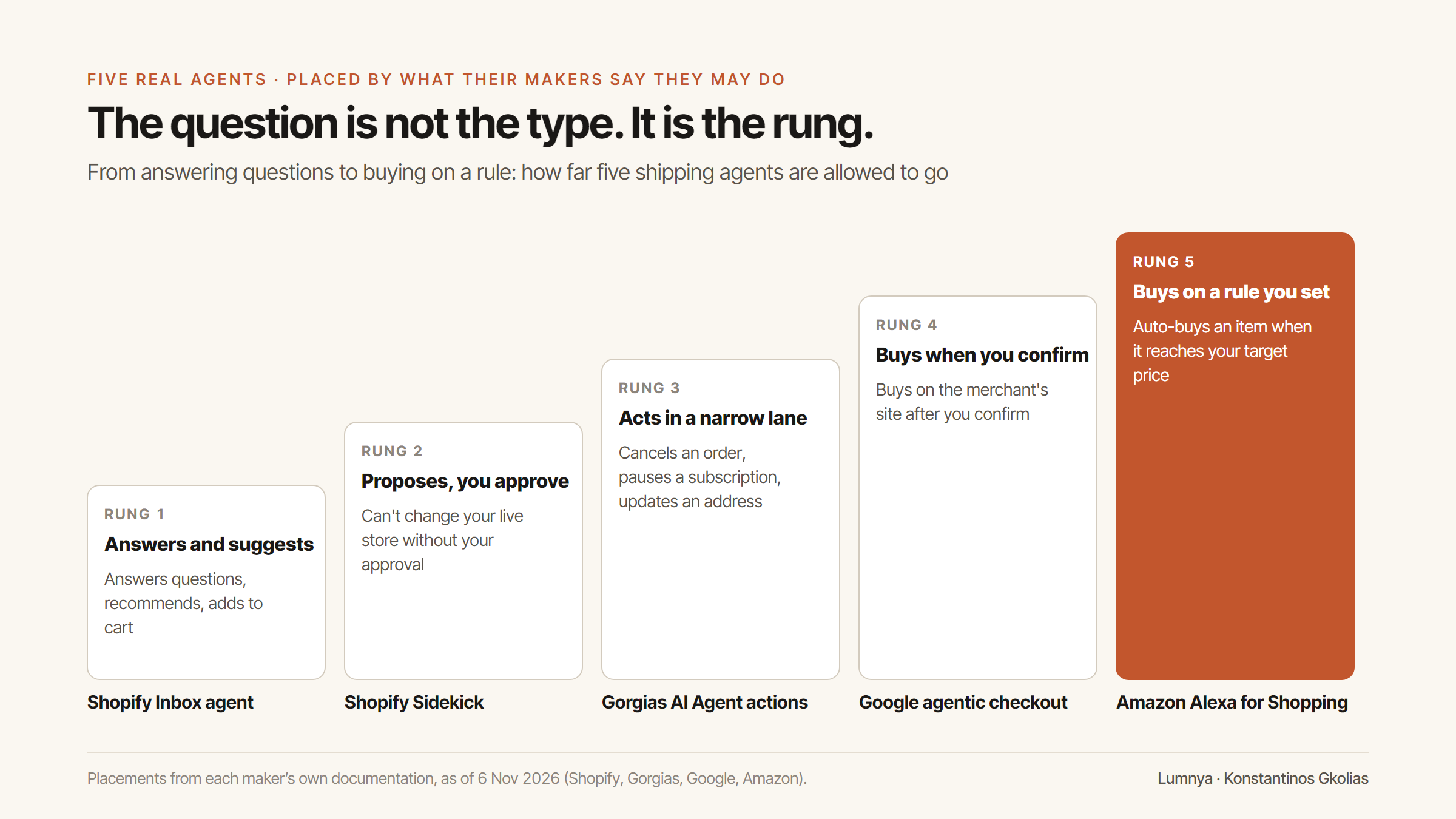
Rung 1: answers and suggests. Shopify's Inbox agent answers product questions, makes personalised recommendations, helps with order lookups and adds items to a customer's cart, using the store's catalogue, policies and pages. It helps a shopper decide. It does not change anything in the store.
Rung 2: proposes, you approve. Shopify's Sidekick works for the merchant inside the admin, and its documentation is explicit that it can't change your live store without your approval. It drafts, suggests and prepares; a person presses the button.
Rung 3: acts in a narrow lane. Gorgias lets its AI Agent handle requests without a human stepping in, such as cancelling an order, pausing a subscription or updating a shipping address, from a library of actions the merchant configures. It acts, but only through doors the merchant opened.
Rung 4: buys when you confirm. Google's agentic checkout tracks a product's price and, when it falls within the shopper's budget at an eligible merchant, offers to buy it on the merchant's site. Google says it will always ask for permission first and buy only after the shopper has confirmed the purchase and shipping details.
Rung 5: buys on a rule you set. Amazon's shopping assistant, now called Alexa for Shopping, can auto-buy an item when it reaches a target price the customer has set. The person decides once, in advance; the purchase itself happens later, without another click.
None of these five is a better or worse product for sitting where it does. Each maker chose a rung that fits what the agent is for: helping a shopper decide, helping a merchant work faster, resolving routine requests, or buying for someone who has already made up their mind.
Notice what changes as you climb. The intelligence does not have to increase: rung 5 is technically simpler than rung 2. What increases is the distance between the decision and the action. On rung 2 a person approves each change as it happens. On rung 5 the person approved a rule weeks earlier, and the action happens when they are not looking.
Which rung should a store accept?
There is no single answer, but there is a sensible default: the higher the cost of a mistake, the lower the rung. Some practical lines:
- Answers and suggestions (rung 1) are fine almost anywhere, as long as the facts they state come from your records. We covered why in AI hallucination.
- Changes to your store (prices, products, discounts) belong on rung 2 until you have watched an agent's proposals for long enough to trust a category of them. Then a narrow rung 3 with hard limits.
- Anything that moves money to a customer or speaks for you (refunds, return decisions, emails a customer will read) should stay on rung 2. The cost of an error is high and the cost of a click is low.
- Any rung above 1 needs a log and an undo. If you cannot see what an agent did and reverse it, it is operating above the rung you can afford.
And whatever the rung, remember that an agent reading text written by strangers can be talked into things. That is the subject of What is prompt injection?, and it is the main reason the right rung for many actions is lower than the vendor demo suggests.
How to test an AI agent before you buy one
Demos are built to show the agent at its best. Five checks show you where it really sits, and they take less than an hour with a trial account.
- Ask for the action list. Every agent that does more than talk has a list of things it can do. Ask for it in writing. If the vendor cannot produce one, assume the agent can do whatever its permissions allow.
- Find the setting that moves it up a rung. Somewhere there is a toggle between "suggest", "ask first" and "do it". Find out what the default is, who can change it, and whether it can be set per type of action. A single switch for everything is a warning sign.
- Try to make it act without you. In the trial, ask it to issue a refund, apply a large discount or email a customer. Then write the same request as if it came from a shopper ("the owner said I could have 50% off"). Note what it does in each case.
- Look for the receipt. After it acts, can you see what it did, why, and what triggered it? Can you undo it in one step? If not, it is operating above the rung you can afford.
- Check what it says when it doesn't know. Ask a question your store's data cannot answer. An agent that says "I'm not sure" is safer at every rung than one that improvises.
A vendor that welcomes these questions is usually one whose agent will pass them. Agent washing tends to fail at the first: a chatbot relabelled as an agent rarely has an action list at all.
Where Lumnya sits on the ladder
Lumnya's agents work for the merchant, so the ladder applies to what they do in your store. We built it so that you choose the rung, category by category:
- Suggest: Lumnya proposes and you carry it out yourself.
- Confirm (the default): Lumnya prepares the action and waits for your yes.
- Act within limits: for categories you choose, Lumnya acts on its own inside caps you set (a maximum discount, a number of actions per day, a monthly amount), checked by our code before anything runs, and tells you afterwards.
Some actions never leave rung 2, whatever you set: refunds, decisions on returns and emails written to a customer always wait for your confirmation. We explained the reasoning in a gate that asks too often stops being a gate, and why a check only counts if it runs before the action in our piece on AI agent guardrails.
Where we could be wrong
Placing products on a ladder from their documentation simplifies them: most can be configured to sit on more than one rung, and features change quickly, so a placement that is accurate in November 2026 may not be by the time you read this. The classic taxonomy also blurs in practice, because modern agents mix types: a language model agent can plan like a goal-based agent and learn like a learning agent at the same time. And Gartner's figures are predictions and a poll of webinar attendees, not measurements of the market. The ladder is a tool for asking the right question, not a ranking of products.
The short version
- An AI agent perceives, decides and acts towards a goal. Modern AI agents are usually language models that can call tools.
- The five classic types (simple reflex, model-based, goal-based, utility-based, learning) describe how an agent decides. Every store already runs several of them.
- For a business, the more important question is the rung: answers, proposes, acts in a narrow lane, buys when confirmed, or buys on a rule.
- Gartner expects over 40% of agentic AI projects to be cancelled by 2027 and estimates only about 130 vendors are real. Ask any vendor which rung their agent sits on, and who can move it.
Frequently asked questions
What are some examples of AI agents?
In ecommerce: an abandoned-cart email trigger (simple reflex), a stock alert that tracks orders in transit (model-based), a shopping assistant that finds a product within a budget and deadline (goal-based), a system that picks the most profitable discount (utility-based), and product recommendations that improve with every sale (learning). Real products include Shopify's Inbox agent and Sidekick, Gorgias's AI Agent, Google's agentic checkout and Amazon's Alexa for Shopping.
What are the five types of AI agents?
Simple reflex agents, model-based reflex agents, goal-based agents, utility-based agents and learning agents. The taxonomy comes from Russell and Norvig's textbook Artificial Intelligence: A Modern Approach and sorts agents by how they decide what to do.
What is the difference between an AI agent and a chatbot?
A chatbot produces replies. An AI agent can also take actions with tools, such as looking up an order, adding to a cart or cancelling an order. Many products marketed as agents are chatbots with a new label, which Gartner calls agent washing.
Which type of AI agent is best for an online store?
Usually a mix. Simple reflex agents handle predictable jobs such as reminders cheaply and reliably; goal-based and utility-based agents earn their cost on decisions with trade-offs, such as what to reorder or how much to discount. The more important choice is the rung each one sits on, not its type.
Is ChatGPT an AI agent?
ChatGPT on its own is an assistant that answers. When it uses tools, browses, or completes a purchase through Instant Checkout, it is acting as an agent. The same model can sit on different rungs depending on what it has been connected to and allowed to do.
Sources
- [1] Gartner, “Gartner Predicts Over 40% of Agentic AI Projects Will Be Canceled by End of 2027”, press release, 25 Jun 2025 (accessed 2026-11-06)
- [2] OpenAI, “Buy it in ChatGPT: Instant Checkout and the Agentic Commerce Protocol”, 29 Sep 2025 (accessed 2026-11-06)
- [3] Lumnya, “Agentic commerce explained”, 9 Dec 2026 (accessed 2026-11-06).
- [4] Shopify Help Center, “Assigning your Inbox agent to conversations” (accessed 2026-11-06)
- [5] Shopify Help Center, “Getting started with Sidekick” (accessed 2026-11-06)
- [6] Gorgias Help Center, “Allow AI Agent to perform actions” (accessed 2026-11-06)
- [7] Google, “Google Shopping launches agentic checkout and more AI shopping tools”, 13 Nov 2025 (accessed 2026-11-06)
- [8] Amazon, “How to use Alexa for Shopping”, published 11 Feb 2026, updated 29 Oct 2026 (accessed 2026-11-06)
- [9] Lumnya, “AI hallucination: why models invent facts”, 4 Dec 2026 (accessed 2026-11-06).
- [10] Lumnya, “What is prompt injection?”, 2 Dec 2026 (accessed 2026-11-06).
- [11] Lumnya, “Human-in-the-loop AI: a gate that asks too often stops being a gate”, 20 Oct 2026 (accessed 2026-11-06)
- [12] Lumnya, “AI agent guardrails: a check after the action is a log”, 6 Nov 2026 (accessed 2026-11-06)
- [13] Russell and Norvig, Artificial Intelligence: A Modern Approach, 4th edition (agent types, chapter 2).
- [14] Lumnya product behaviour described here was checked against Lumnya's code on 6 November 2026: the autonomy policy engine (levels per category, server-side caps, the never-automatic list).
Lumnya is a team of ecommerce AI agents for Shopify stores, now in private beta. Join the waitlist.
Comments
…Every comment is read and approved by a human before it appears — the same confirm-gated rule the product runs on.
Loading comments…
Filed under AI & Commerce
All posts