
A clearance price set in late October is a price signal your shoppers will remember in late November. The clean way to clear dead stock before Black Friday on 27 November is the opposite of a store-wide sale: aim at the item, put a floor under the price, put a date on the end, and look at what happened a week later. This is the checklist we'd run in an afternoon.
Why late October is the dangerous month
Every year, the same calendar plays out. Shops notice in October that some products haven't moved. The warehouse, the cash and the Black Friday plan all need the space. The obvious move is a sale. Twenty percent off everything for a week, and the problem's gone.
The problem with that move is what it teaches.
Adobe's forecast for this year's US holiday season sets out the shape of the discounts shoppers will see: up to 14% off in early November, up to 21% just before Thanksgiving, and up to 30% during Cyber Week, with 10–15% through December. That's the market's curve. It climbs towards the last week of November, and shoppers know it climbs.
Now put a store-wide 20% sale in the last week of October on that curve. You've just offered more than the market will offer in early November, a full month before the peak. A shopper who sees that doesn't conclude that your shop is generous. They conclude that your shop discounts, early and deep, and that if they wait for Black Friday it'll be deeper still. You've moved your own customers from "buy now" to "wait".
Figure 1 · The season's discount curve
A store-wide 20% in late October beats the market's early-November discount
Adobe's forecast of the deepest US online discounts this holiday season, against a store-wide sale run a month early.
The market, up to (Adobe forecast)
- Early November14%
- Just before Thanksgiving21%
- Cyber Week30%
- December (10–15%)15%
Your store, a month early
- Store-wide sale, late October20%
It also has a second cost: the products that would have sold at full price this week sell at 20% off instead. A store-wide sale clears the slow stock and discounts the fast stock in the same stroke.
The way out is not to avoid clearing stock. It's to clear it in a way that doesn't move the price of anything else, and doesn't teach anyone anything about next month.
Rule 1: aim at the item
Before you discount anything, find out which products are actually stuck. Two numbers do most of the work, and you can get both from your order export.
Days since the last sale. How long ago did anyone buy this? A product that sold yesterday isn't dead stock, however much of it you have.
Weeks of cover. Units on hand divided by units sold per week. Forty units selling two a week is twenty weeks of cover: that's not a Black Friday problem, it's a spring problem.
The products you want are the ones where both are bad: no sale in a long time and enough units that waiting costs you something. Everything else stays at full price.
Figure 2 · Find the stuck stock
Discount only where both numbers are bad
Days since the last sale against weeks of cover, for an illustrative outdoor-clothing shop.
↑ Weeks of cover
Over-ordered: buy less next time
Stuck: clear it, narrowly
Healthy: leave it alone
Few left: let it sell out
Days since the last sale →
In Lumnya, the Liquidation Planner applies a rule of this kind on its daily run, so you can see how a concrete version looks. A product is flagged as dead stock only if all of these hold:
- it's active in your store,
- you have at least 5 units,
- it has had at most one order across the current calendar month and the two before it,
- and it was created at least 30 days ago, so a new arrival isn't mistaken for a failure.
That's deliberately narrow. It will miss products that are selling slowly but steadily; those are better handled by ordering less next time than by discounting now.
Rule 2: put a floor under the price
The second mistake after "everything" is "as much as it takes". A clearance discount should have a ceiling you set before you start, and a floor that protects you from selling below what the product cost you.
The floor is your cost. Below it, every sale loses money. If you know the unit cost of the product, the first price you write down is that one.
The ceiling is your rule, not the moment's mood. Decide the most you'll ever take off for clearance, and keep it below what the market will offer on Black Friday itself. If your clearance discount is deeper than your Black Friday discount, you've told shoppers when not to buy.
Start small. The first step is the smallest discount that might work, not the one that's sure to. You can always go further next week. You can't easily go back.
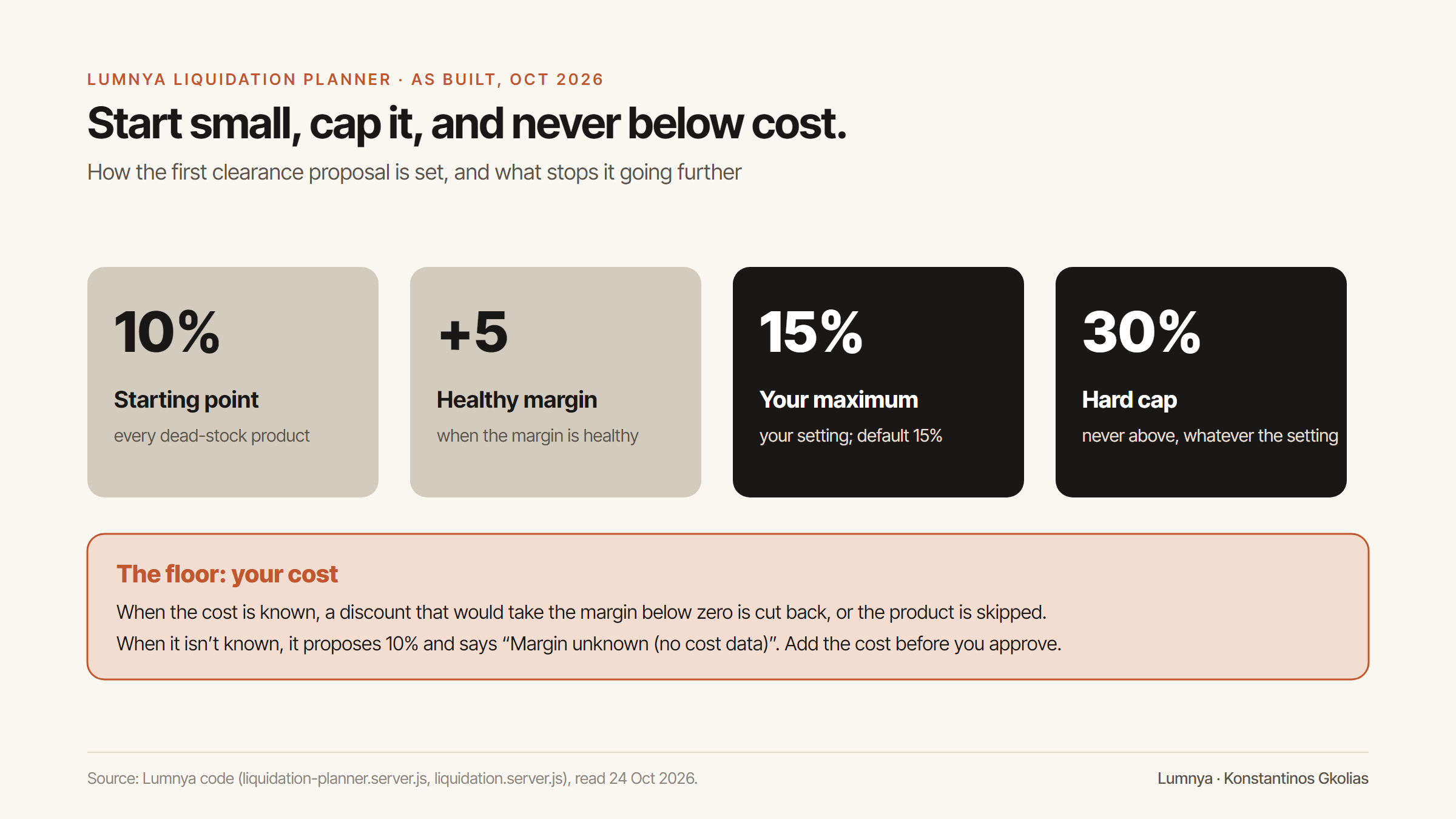
Here's how Lumnya's Liquidation Planner sets its first proposal, as an example of a ladder with a floor:
- it starts at 10%,
- adds 5 points when the product's margin is healthy,
- never goes above 30%, and never above your store's own maximum discount setting, which is 15% unless you change it,
- and, when it knows the product's cost, it cuts the discount back, or skips the product, rather than propose a price that would take the margin below zero.
When it doesn't know the cost, it still proposes 10% and says so: "Margin unknown (no cost data)". That's your cue to add the cost before you approve anything.
The arithmetic of a discount
It's worth doing this sum once, because it changes how small "small" feels.
Take a product that sells for 100 and cost you 60. Your margin on each sale is 40. Now take 15% off. The price is 85, the cost is still 60, and your margin is 25. A 15% discount has cut the profit on each unit by more than a third.
To make the same total profit at the lower price, you'd need to sell 60% more units than you would have at full price. At 20% off, the margin drops to 20, and you'd need to sell twice as many. At 30% off, the margin is 10, and you'd need four times as many.
Figure 3 · The arithmetic of a discount
At 30% off, you need four times the sales to make the same profit
A product that sells for 100 and cost 60: how many units at the discounted price earn what one unit earned at full price.
Units needed for the same profit
- Full price · margin 401×
- 10% off · margin 301.33×
- 15% off · margin 251.6×
- 20% off · margin 202×
- 30% off · margin 104×
For a product that wasn't selling at all, this isn't a reason not to discount: zero units at full price makes no profit either, and the cash is stuck. But it is a reason to start low. On a product with a 40% margin, the difference between 10% off and 20% off isn't ten points of price. It's the difference between giving away a quarter of your margin and giving away half of it.
The numbers above are an illustration; your margins will differ. Run the same sum with your own cost before you choose a percentage. If you don't know the cost, that's the first thing to fix.
Rule 3: choose the narrowest channel
A markdown on the product page is the loudest way to clear stock: everyone sees it, including the shoppers who would have paid full price for something else today. There are quieter options, and they're often better before Black Friday.
A code for that product only. A discount code that applies to one product reaches the shoppers who are already looking at it, and nobody else. When you approve a clearance proposal in Lumnya, it creates exactly that: a real Shopify discount code for that single product, named CLEAR plus the percentage and a short random suffix. It doesn't touch any other price in the store.
A pairing. Some slow products sell well next to something else. If shoppers who buy the jacket often buy the gloves too, the gloves may not need a discount at all; they need to be in front of the jacket buyer. Lumnya's Bundle Discovery looks for exactly this every Monday: pairs of products bought together in at least three orders over the last three months, more often than chance would explain. It recommends them to you, and the storefront chat starts showing the pair together when a shopper opens one of them. It doesn't create a bundle product for you; if you want a priced bundle, you build it in Shopify.
A markdown. Sometimes a visible price cut is the right tool: when the product is clearly end-of-line and the shopper should know it. Even then, cut that product, not the store.
Rule 4: date the end
A clearance with no end date stops being a clearance. It becomes the product's new price, and the next time you raise it, shoppers will notice.
So every clearance gets an end date before it starts. One or two weeks is usually enough to learn whether the price works. The end date before Black Friday matters most: you want the clearance finished, and your normal prices back, before the market's discount curve peaks.
Be aware of how your tools behave here. Lumnya's clearance codes don't expire on their own today. The code is created with no end date, and you end it with the "End" button, which deactivates it. If you want a fixed end, set the end date on the code in Shopify when you approve it, or put a reminder in your calendar. We'd rather you know that now than discover it in December.
Rule 5: look a week later
The last step is the one most shops skip. A week after the clearance starts, look at what happened.
- Did it sell? If the units moved at 10%, you didn't need 20%.
- Did it sell to whom? If the buyers were existing customers who would have bought anyway, you gave away margin. If they were new, the clearance did more than clear.
- Did anything else slow down? If full-price sales of similar products dipped during the clearance, the discount taught the wrong lesson.
Lumnya keeps three counters on each approved clearance: how many shoppers were shown the offer, how many engaged with it, and how many bought. And if a product starts selling again on its own, its clearance proposal is withdrawn automatically, so you're not prompted to discount something that has recovered.
If it didn't sell, don't just cut deeper. A product that didn't move at 10% might move at 20%, but it might also not move at any price before Christmas, because the problem isn't the price. Ask the other questions first. Is it visible: does anyone see it on the way to something else? Is the page honest: are the photos, the sizes and the description good enough that a shopper could decide? Is it the wrong season: a summer product in November is waiting for April, not for a discount? Only when the answer to all three is "yes, it's fine", is a deeper cut the next step, and even then, one step, with a new end date. A clearance that becomes a slide down the price ladder all month is exactly the lesson you didn't want to teach before Black Friday.
Three products, one afternoon
Here's the checklist applied to an illustrative shop that sells outdoor clothing. The products and numbers are invented; the decisions are the ones we'd make.
The rain jacket in olive. Eighteen units on hand. One order in the last three months, and that was in August. The black and navy versions of the same jacket sell every week. This is dead stock in the plainest sense: the product is fine, the colour isn't. The cost is known, the margin is healthy, so the first step is a 10% code for the olive jacket only, ending in ten days, well before Black Friday. No banner, no email to the whole list. The code goes to the shoppers who look at the olive jacket, and to the chat when someone asks about it.
The merino socks. Forty units, selling two a week, steadily. Twenty weeks of cover. That's a lot of socks, but they're not stuck; they're over-ordered. A discount would sell them faster and teach the regular buyers that socks are cheaper in October. The right decision is no discount at all, and a smaller order next season.
The touchscreen gloves. Twelve units, almost no sales on their own. But in the orders that do include them, they nearly always sit next to the winter parka, one of the shop's best sellers. The gloves don't need a lower price. They need to be in front of the person buying the parka. So they get paired: shown alongside the parka in the shop and in the chat, at full price. If they're still there in two weeks, then they get a small code of their own.
Three products, three different answers, and only one of them is a discount. That's the point of aiming at the item: most slow stock isn't a pricing problem, and the shops that treat it as one end up cutting prices they didn't need to cut.
A week later, the shop looks again. The olive jacket sold eleven of eighteen at 10%: the code can run to its end date and the rest can wait for spring. The gloves sold five next to the parka without a discount. The socks are where they were, as expected. Nothing in the shop's full-price sales dipped, because nothing else changed price.
What not to do in the four weeks before Black Friday
- Don't run a store-wide sale. It clears the slow stock and discounts the fast stock at the same time, and it teaches shoppers to wait.
- Don't call it a "pre-Black Friday sale". You're telling shoppers that the real sale is coming.
- Don't discount your best sellers to make room. If they sell at full price in October, they'll sell at full price in November.
- Don't let a clearance run into Black Friday. Either it worked and it's over, or it didn't and the product needs a different answer, not a deeper cut on the busiest day of the year.
The afternoon checklist to clear dead stock
- Export your products with units on hand and your orders for the last three months.
- Mark every product with no sale in the last three months and at least a handful of units.
- For each one, write down the unit cost. That's the floor.
- Decide your ceiling: the most you'll take off for clearance, below your Black Friday discount.
- Check whether the slow product sells well next to another one. If so, pair it before you cut it.
- For the rest, start with the smallest discount that might work, on that product only.
- Give every clearance an end date, a week or two out, and before Black Friday.
- A week later, look: did it sell, to whom, and did anything else slow down?
None of this needs software. It needs a list, a floor and a date. Lumnya does the list and the floor for you every day, and asks before it changes anything (unless you've switched on autopilot for clearance, within limits you set). The date, for now, is yours.
For the other side of the same month, the products that will run out rather than sit, see the Black Friday reorder check. For reorder points all year round, see what Shopify replaced after Stocky, and for what shoppers ask for that you don't stock at all, counting unmet demand.
Frequently asked questions
How do I clear dead stock before Black Friday without a store-wide sale?
Aim at the products that are actually stuck: a long time since the last sale and many weeks of cover. Put your cost under the price, use the narrowest channel, put an end date on the offer, and look at what happened a week later.
How much discount does dead stock need?
Less than it feels like. With a 40% margin, 20% off means selling twice as many units to keep the same profit. Start small, cap it, and never go below cost.
Why not run a store-wide sale in October?
It discounts your fast sellers too, and it shows shoppers your prices fall early and deep. Adobe's forecast puts early-November deals at up to 14%; a 20% sale in October is ahead of that, a month before the peak.
Sources
- [1] Adobe, “U.S. Holiday Shopping Season to Hit Record $275.1 Billion Online, Rising 6.7% YoY”, 28 Sep 2026 (accessed 24 Oct 2026).
- [2] Lumnya product behaviour described here was checked against Lumnya's code on 24 October 2026 (Liquidation Planner, clearance approval and discount codes, Bundle Discovery, shopper signals).
Lumnya is a team of ecommerce AI agents for Shopify stores, now in private beta. Join the waitlist.
Comments
…Every comment is read and approved by a human before it appears — the same confirm-gated rule the product runs on.
Loading comments…
Filed under Operators' Playbook
All posts